Government announces Local Government Reorganisation decision for Lancashire
The Government has today announced its decision on Local Government Reorganisation (LGR) in Lancashire.
This decision, subject to Parliamentary approval, represents the biggest change in local government in more than 50 years.
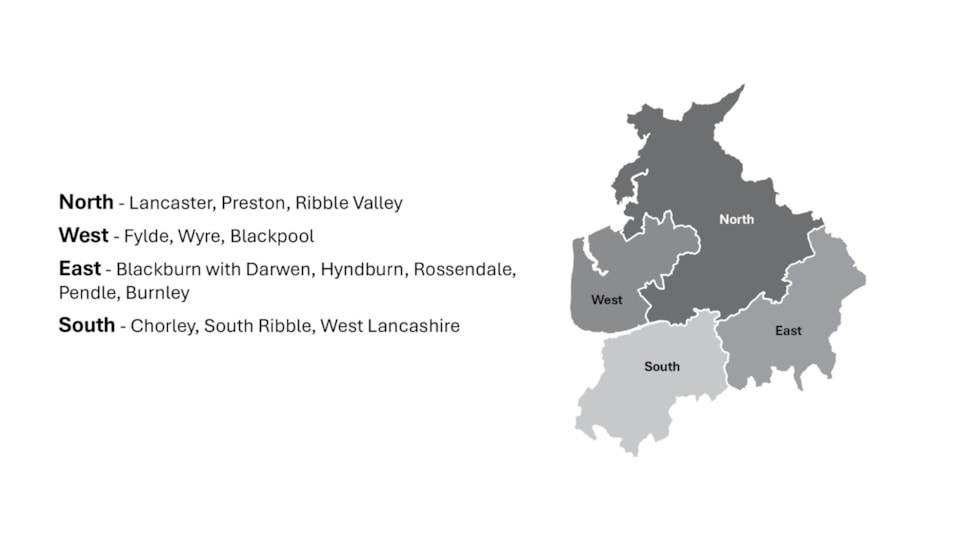
Under the plans four new unitary councils will be created, replacing all 15 existing councils. The new unitary councils will cover:
North Lancashire – made up of Lancaster, Preston and Ribble Valley
West Lancashire – made up of Fylde, Wyre and Blackpool
East Lancashire – made up of Blackburn with Darwen, Hyndburn, Rossendale, Pendle and Burnley.
and
South Lancashire – made up of Chorley, South Ribble and West Lancashire
The changes, which are subject to Parliamentary approval, will see the new unitary councils take responsibility for all local services in their areas.
The Government has confirmed that elections to the new shadow councils will take place in May 2027. All councils have been working together to do the necessary preliminary work to prepare for this and there is a team ready to implement the changes needed for the new unitary councils going live on 1 April 2028.
For now, all current 15 councils will continue to provide high-quality services to residents and communities with no immediate changes to how those services are delivered or accessed.
A spokesperson for Lancashire’s LGR Board of Chief Executives, said:
“Today’s announcement marks an important milestone for Lancashire.
"While there will understandably be a great deal of interest in what this means for our residents, businesses and communities, it is important to stress that for now, it is very much business as usual.
“No matter how we are reshaped, our priority remains unchanged – to continue delivering high-quality services while we work together across Lancashire to plan the next steps.
“There is strong collaboration already in place. By working together, we have a real opportunity to create something positive for our residents, communities and workforce. This is a long-term change, and there is time to ensure the transition is carefully managed.
“We recognise that change of this scale can bring uncertainty. We are committed to being open and transparent throughout the process, keeping residents, staff and partners informed as more details become available.”
Local Government Reorganisation is part of a wider national programme intended to create simpler and more effective council structures.
The Government has said residents should see no disruption to services as these changes are made, and councillors will continue in their roles representing and supporting their communities throughout the transition.
Further updates, including key milestones and opportunities to ask questions, will be shared over the coming months as plans develop. More information is available at www.lancashirelgr.co.uk.
Notes to editors
Background
- In February 2025, government invited Lancashire councils to explore Local Government Reorganisation (LGR), as part of the wider national plan called the English Devolution and Community Empowerment Bill.
- LGR means the current structure of local councils will change. At the moment, Lancashire has a two-tier system of local government:
- one county council,
- twelve district councils, and
- two unitary authorities.
- In a unitary model, one council is responsible for delivering all local services in its area, with the aim of making services simpler and more efficient for residents.
What’s happening in Lancashire
- In March 2025, all 15 Lancashire councils submitted a joint Interim Plan to government.
- All 15 councils then worked together to develop a shared set of data and evidence to inform proposals.
- Using that shared evidence, councils developed their preferred options and submitted five separate proposals to government in November 2025.
Government’s preferred option (subject to Parliamentary approval)
- Government has announced that its preferred option for Lancashire is the four unitary authority model, subject to Parliamentary approval. This will become legal once a Structural Change Order (SCO) is in place later this year.
- This would mean Lancashire will have four unitary authorities (details to be confirmed).
- These unitary authorities would replace the current 15 councils from 1 April 2028.